Background to Soulmaidens
Article 19.8.2026
Soulmaidens, the first production of FiBO’s three-year collaboration with the Finnish National Opera, premieres at the Finnish National Opera’s Almi Hall on 8 October, with further performances on 9–10 October. In this text, directors Siljamari Heikinheimo and Niina Lindroos and musical director Marianna Henriksson explore the background of the work.
What inspired Soulmaidens, and what is the work fundamentally about?
Siljamari Heikinheimo: “I have admired Niina’s aesthetic and performances for a long time. I had a strong intuition that I wanted to see her raw, sculptural aesthetic combined with baroque opera. Manna’s (Marianna’s) extensive knowledge of early music led us to Monteverdi’s Il ballo delle ingrate (The Ungrateful Women) and from there to the lament from Monteverdi’s opera L'Arianna, the only surviving piece of music from the work. Both were composed as moralities for a wedding celebration in 1608. They deal with the regulation of female desire in the service of social norms: the ungrateful souls have closed their hearts to love, while Arianna has loved too much. Those who defy the patriarchy face death or the underworld. It felt compelling to bring these two works together into a whole that explores female desire.
Together, the works ask: what does love do to us, and how do our experiences shape us? Is it possible to find a state of grace and gentleness within ourselves and our surroundings, and surrender to its support?”
How do you bring the atmosphere and inner worlds of the characters to life on stage?
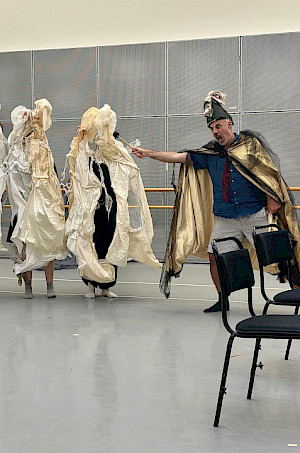
Siljamari Heikinheimo and Niina Lindroos: “We approach the characters above all as mythical forces that move us. Venus embodies the intoxication of love, Cupid the unpredictability of falling in love, and Pluto order. Arianna is a human being moving through these forces.
In our work, we constantly seek connections between music, movement, puppetry and stage imagery. Our aim is to create a world in which the audience can experience the intoxication of love, loss and, ultimately, grace.”
Puppetry creates a distinctive visual world. What can puppets and puppetry express in this story that human performers could not?
Niina Lindroos: “Puppetry is, for example, about conveying a story or atmosphere through materials and stage imagery. At the beginning of the design process, I asked what could work with puppets in this piece, and how. One starting point for Siljamari and me has been the question of what happens to the soul when a person dies. This became a thread running through the work, influencing the puppets and other visual elements.
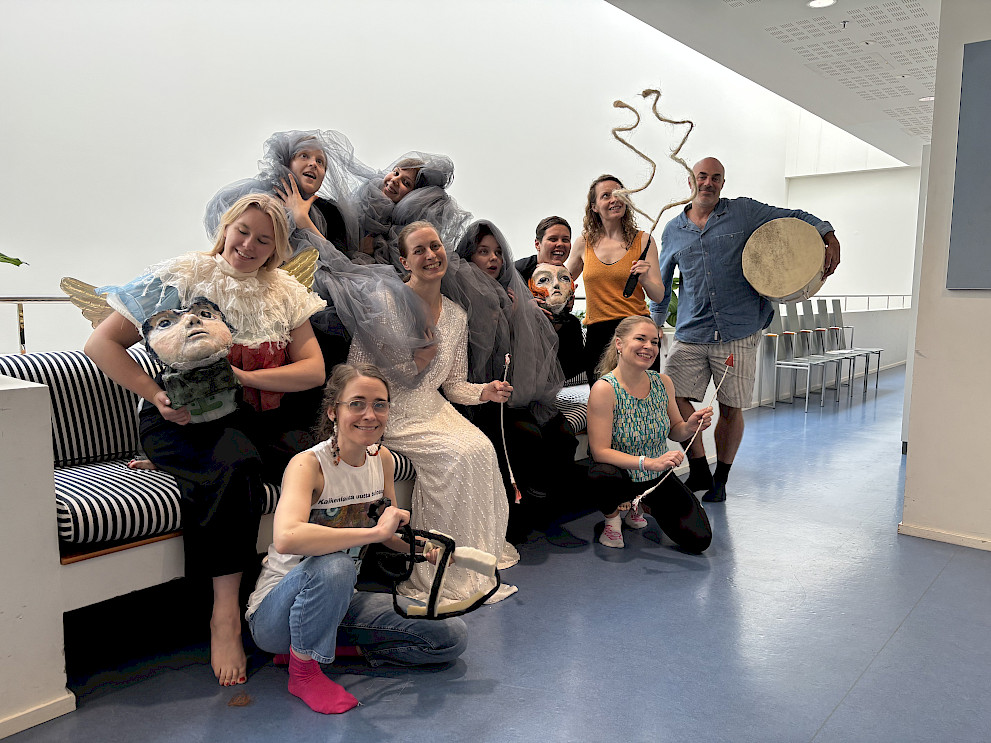
Our aim has been for the puppets, in all their forms, to support the music and, if possible, make it even more vivid. At the same time, I have also used them to illustrate the themes of the work, some of which are abstract. The souls in Il ballo delle ingrate were easy to imagine as puppets. I wanted to create these figures, arbitrarily imprisoned somewhere in the dark depths for eternity. I wanted to show their faces and somehow embody in the face of a great soul-puppet the part of the work that moves me most: the melancholy and sensitivity of the music.
While listening to Arianna’s lament, I wondered how her emotions could become a puppet. I have also searched for the right materials and explored different puppetry techniques. Siljamari dreamed of long hair on stage, so we had to find it and discover how to make it work as puppetry. A very “hairy" part of the process.”
How does the music carry the story, and what makes its musical world special? Are there particular musical details the audience should listen for?
Marianna Henriksson: “Monteverdi’s Il ballo delle ingrate has fascinated me for a long time. It is a relatively short (about half an hour) ceremonial stage work, and its score and accompanying materials contain detailed information about the visual aspects of the original production. It is fascinating to imagine how the boundaries of the stage were crossed at the 1608 wedding celebration, when members of the court joined the dance and the characters addressed audience members directly. The contradictions in the text are fertile ground, while the stage directions are inspiring. The work also gives the instrumentalists a central role: at its heart—and presumably originally one of its theatrical highlights—is the ballo, a long dance scene consisting entirely of instrumental music.
When Siljamari and I considered which relatively small-scale opera could form the basis of our collaboration, Il ballo delle ingrate felt like a natural starting point. It can be expanded with instrumental music into a larger whole, and Siljamari’s suggestion to add Arianna’s lament soon began to feel like an excellent idea. Arianna’s lament mirrors the lament of the ‘Soulmaiden’ that ends Il ballo delle ingrate. We also know that at the 1608 premieres, both characters were performed by the same famous actress, Virginia Andreini, whose performances moved audiences to tears.
In Il ballo delle ingrate and Arianna’s lament, the instrumental material is very sparse. The only substantial ensemble writing is a five-part dance music; otherwise, there is simply a bass line harmonised and coloured by the continuo instruments. I have also written ‘continuo’ parts for instruments beyond the traditional continuo group, seeking the richest possible palette of colours for the characters and their words. Sonically, we aim to create a tattered grey veil, a seductive love spell, grotesque Underworld ‘mansplaining’, light gold dust—and whatever else emerges. The sound world is further expanded by the electronic extensions created by Tuomas Norvio.”
The work premiered in 1608. What can it bring to the present day, and what perspectives do you want to highlight?
Siljamari Heikinheimo: “I think the themes of love and death are timeless, both in life and in opera. Questions of female desire, and of finding grace and gentleness, also feel highly relevant today.
In the performance, Arianna embarks on a mythical journey through the intoxication of love, the demands of order and chance encounters, towards grace. Ultimately, the most interesting question becomes how we can face our own vulnerability and find the feeling that we do not have to carry everything alone.
Although the starting point is more than 400 years old, the questions these works raise about love, power, freedom and humanity still speak strongly to audiences today.”
How has your collaboration developed during the rehearsal process? Do music and direction inspire new impulses in one another?
Niina Lindroos: “It has been such a joy to make this piece! The team is amazing. The process has felt very natural while also being completely new to me. It has been fascinating to watch Siljamari direct, Manna lead the music, and to see how the singers and instrumentalists work. It is incredibly exciting how music and text provide a key that unlocks the work. At the same time, it is somehow so obvious—and so magical.”
What do you hope the audience will experience or take away after the performance?
All: “We hope the work makes the audience’s hearts sing.”
Soulmaidens on FiBO’s website
Buy tickets directly from the Finnish National Opera